
Masterpieces by the Hofvijver
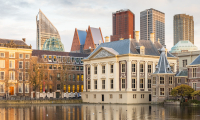
The Mauritshuis houses world-famous paintings from the Golden Age, such as Vermeer’s *Girl with a Pearl Earring*, Potter’s *The Bull* and Rembrandt’s *The Anatomy Lesson*. In a stylish 17th-century city palace, right next to the Binnenhof, you can admire over 250 masterpieces by Dutch and Flemish painters.
The combination of world-class art, intimate rooms with silk wall hangings and chandeliers, and the central location make this museum a must-see in The Hague.


In this small museum of world-class standing, you can see an extraordinary collection of world-famous 17th-century Dutch and Flemish paintings.
Mauritshuis – Royal Picture Gallery
With its world-famous collection of paintings and magnificent historic building, the Mauritshuis is a gem in the heart of the royal capital, right next to the Binnenhof and within walking distance of outdoor cafés and the shopping district. Masterpieces such as Vermeer’s Girl with a Pearl Earring, Rembrandt’s The Anatomy Lesson of Dr Nicolaes Tulp, Fabritius’s The Goldfinch and Potter’s The Bull are on permanent display in this magnificent museum on the Hofvijver.
Paintings from the 17th and 18th centuries
Over 250 masterpieces by Dutch and Flemish masters are on display in the compact, classical interior, which exudes an intimate atmosphere thanks to the silk wall hangings, sparkling chandeliers and monumental ceiling paintings. Landscapes, interiors, (flower) still lifes and portraits offer a rich and varied picture of 17th- and 18th-century painting. Nowhere else in the Netherlands will you find so many masterpieces per square metre! The museum has its own brasserie and a shop selling lovely gifts.


The building and the galleries at the Mauritshuis are works of art in their own right!
Home of *Girl with a Pearl Earring*
One of the most iconic paintings in the world hangs in the Mauritshuis. *Girl with a Pearl Earring* is by the Delft painter Johannes Vermeer. He painted it between 1665 and 1667. The painting is not a portrait but a *tronie*. The girl has never been identified.
Dutch Classical Baroque
The Mauritshuis was built between 1633 and 1644 for Count Johan Maurits of Nassau-Siegen, Governor of Dutch Brazil. Following a fire in 1704, the Mauritshuis was given an 18th-century interior. Since 1822, the Mauritshuis has been a museum, officially known as the Royal Cabinet of Paintings. The building housing the museum is one of the earliest and finest examples of Dutch Classical Baroque. This architectural style is characterised, among other things, by columns running the full height of the façade and decorative sculptural elements.
Accessibility at the Mauritshuis for people with disabilities
To ensure everyone can enjoy their visit to the Mauritshuis to the full, a number of facilities are available for people with a disability, physical impairment, mobility issues and/or visual impairment. Want to know more? Please check here before your visit.
How do I get to the Mauritshuis?
By public transport
From The Hague Central Station, it’s a ten-minute walk to the Plein. You can also take tram 16 or 17 for one or two stops.
From The Hague Hollands Spoor Station, take tram 1 or 9 (towards Scheveningen). Tram 16 stops just a few minutes’ walk from the museum.
By car
Follow signs for ‘Centrum’ and then follow the signs for the Mauritshuis. Park in the Pleingarage next to the Mauritshuis or at Interparking Museumkwartier. Alternatively, park at Malieveld or The Hague Central-New Babylon (10-minute walk).

Look closely into the eyes of the Girl with a Pearl Earring!
Combined ticket for the Mauritshuis and the Prince William V Gallery – The Netherlands’ first museum
Visit the Mauritshuis and the Prince William V Gallery with a combined ticket for just 24 euros. A single ticket for the Gallery costs 8.50 euros and is only available at the ticket office at the Gevangenpoort (not online). With this combined ticket, you gain access to the oldest museum in the Netherlands: the Prince William V Gallery. Admire some 150 masterpieces in the historic hall dating from 1774.
The walls are covered from floor to ceiling with 17th-century paintings.
The Prince William V Gallery is what you might call a hidden gem in The Hague. In 1774, William V, Prince of Orange-Nassau, had this gallery built specifically on the Buitenhof to present his impressive art collection to the public. This was remarkable, as it was the first time a high-ranking figure had made his art collection accessible to ‘ordinary’ visitors. It became the very first museum in the Netherlands. At that time, it was customary to hang the walls crammed full of paintings, from floor to ceiling. Symmetry was important, but above all the sense of opulence. Not a single space was left empty.